| 英文摘要 |
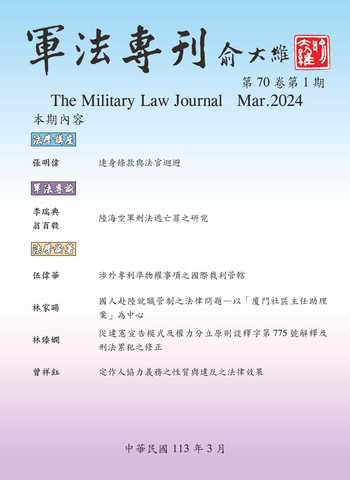
This article systematically examines the challenges of protecting submarine cables from an international law perspective, while offering recommendations tailored to Taiwan's specific circumstances. It is well established that modern society is heavily dependent on submarine cables for transmitting internet data. In recent years, a series of cable damage incidents have occurred in the Baltic Sea, the North Sea, and the waters surrounding Taiwan, with the suspected vessels frequently identified as Chinese—flagged ships or vessels under Chinese beneficial ownership—making it difficult to rule out the possibility of deliberate sabotage as part of“grey zone warfare”.
Against this backdrop, the article examines the existing international legal framework governing submarine cable protection, from the 1884 Convention for the Protection of Submarine Telegraph Cables to the 1982 United Nations Convention on the Law of the Sea (UNCLOS). Under current international law, however, coastal States enjoy full enforcement jurisdiction only within their territorial seas. Once a damaging act occurs in the exclusive economic zone (EEZ), on the continental shelf, or on the high seas, enforcement jurisdiction belongs in principle to the flag State rather than the affected coastal State—creating a significant enforcement gap.
The article then evaluates several proposed remedies: invoking the doctrine of necessity, assimilating cable sabotage to piracy so as to claim universal jurisdiction, applying the doctrine of constructive presence, amending UNCLOS, negotiating a new specialized convention, or seeking authorization through a UN Security Council resolution. Each option is examined and found to face substantial legal or political obstacles; in particular, opposition from China and Russia renders Security Council authorization or treaty amendment mechanisms virtually unworkable.
Turning to State practice, the article surveys measures adopted within the existing legal framework, including the establishment of submarine cable protection zones by Denmark, Australia, and New Zealand, as well as NATO's“Baltic Sentry”mission, all aimed at strengthening surveillance and deterrence. Notably, even the Australian model—widely regarded as world best practice—is limited to imposing criminal liability on its own nationals.
Finally, the article recommends that Taiwan make full use of its enforcement jurisdiction within the territorial sea, strengthen patrols in relevant maritime zones, and proactively exercise the right of visit against suspect vessels in a manner consistent with international law. Where there are sufficient grounds, Taiwan should also consider invoking the doctrine of necessity to justify boarding vessels suspected of causing damage beyond the territorial sea. In the longer term, Taiwan should actively engage in regional cooperation, establish information—sharing mechanisms, and advocate for treating deliberate submarine cable sabotage as a matter subject to universal jurisdiction—thereby safeguarding national communications security and upholding the international legal order. |





 本站僅提供期刊文獻檢索。


